In the ever-evolving world of cybersecurity, the need for smarter, faster, and more adaptive tools is growing at an unprecedented rate. One of the most exciting developments to emerge in this space is Kali-GPT — an advanced AI model engineered specifically to assist in both offensive and defensive cybersecurity tasks. Named as a hybrid tribute to the popular Kali Linux distribution and the GPT (Generative Pre-trained Transformer) architecture, Kali-GPT aims to revolutionize how cybersecurity professionals operate in digital battlegrounds.
In this article, we’ll explore what Kali-GPT is, how it can be used, and its potential advantages and limitations in real-world scenarios.
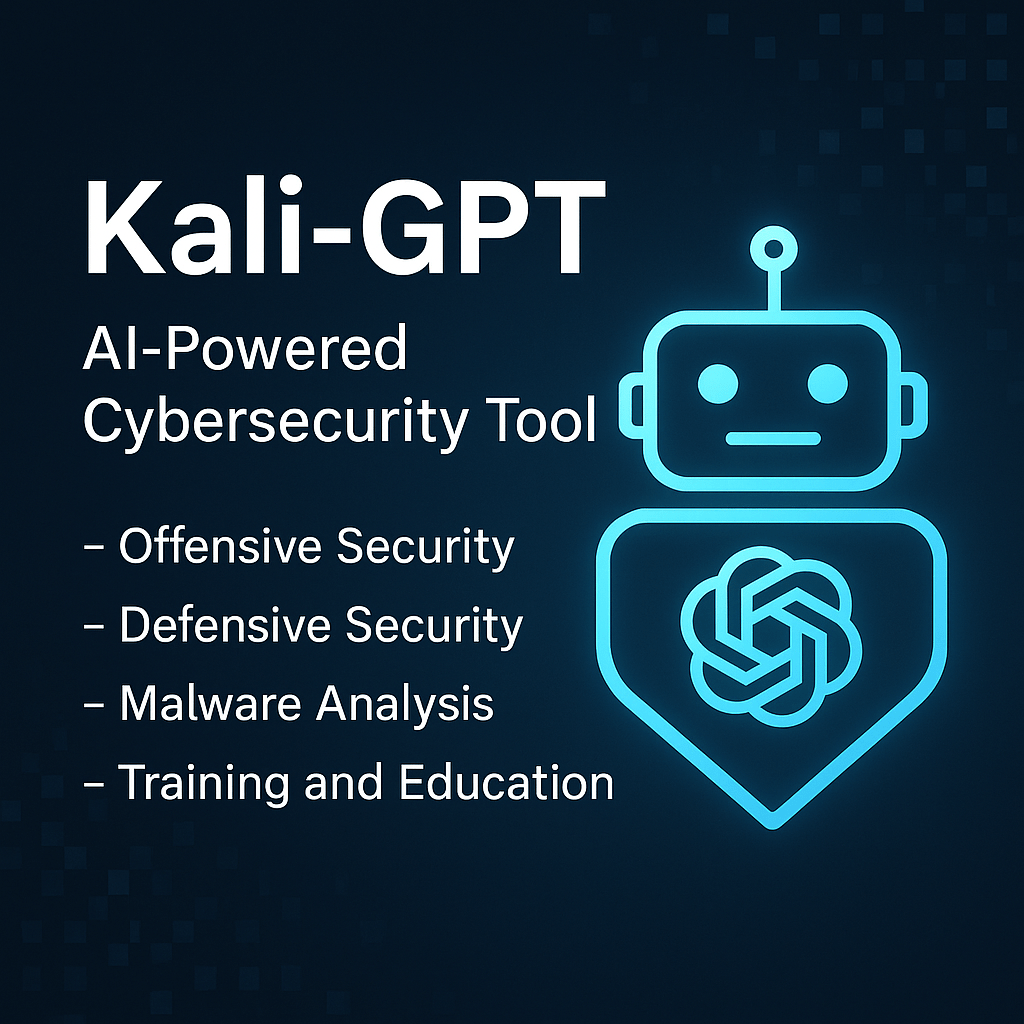
What is Kali-GPT?
Kali-GPT is a specialized large language model (LLM) designed to function as a cybersecurity assistant. Inspired by the capabilities of OpenAI’s GPT models, it integrates the structure and syntax of AI with a focus on cybersecurity contexts — particularly penetration testing, ethical hacking, digital forensics, malware analysis, and security hardening.
Unlike general-purpose AI models, Kali-GPT is tailored with a training dataset enriched by security manuals, exploit documentation, CVE databases, code snippets from penetration testing tools, and behavioral data from real-world security events. This makes it uniquely positioned to assist cybersecurity professionals in understanding, writing, and executing tasks related to both offense and defense in cyberspace.
Key Use Cases of Kali-GPT
1.
Offensive Security (Ethical Hacking)
Kali-GPT can help security researchers and ethical hackers generate payloads, craft phishing templates, or write custom scripts for scanning vulnerabilities. It can even simulate basic penetration testing workflows and generate reports that mimic the structure used by real-world red teams.
- Example: Kali-GPT can generate a Metasploit payload for a specific exploit scenario, or explain the steps needed to bypass a particular firewall configuration.
2.
Defensive Security (Blue Team)
Blue teams can use Kali-GPT to analyze logs, identify anomalies, suggest firewall rules, and even respond to active security incidents. It can work as a co-pilot during incident response by summarizing threat intelligence data or suggesting countermeasures.
- Example: Given a suspicious log entry, Kali-GPT might correlate the data with known attack patterns and suggest a remediation plan.
3.
Malware Analysis
Security analysts often need to deconstruct malicious binaries or scripts. Kali-GPT can assist in reverse engineering, de-obfuscating code, and providing explanations for what the malware is doing, line by line.
- Example: Uploading a snippet of obfuscated PowerShell can yield a human-readable breakdown of its function and risk level.
4.
Training and Education
Kali-GPT is also an invaluable tool for training the next generation of cybersecurity professionals. It can generate realistic lab environments, mock interviews, quizzes, and explain complex topics like buffer overflows or privilege escalation in simplified terms.
Pros of Kali-GPT
✅
Accelerated Workflows
Kali-GPT dramatically reduces the time it takes to perform routine tasks such as vulnerability scanning, payload generation, or SIEM log analysis. This is especially beneficial for professionals managing large-scale infrastructures or SOC (Security Operations Center) teams dealing with multiple threats simultaneously.
✅
Knowledge Access On-Demand
Whether you’re a junior analyst or a senior penetration tester, Kali-GPT allows quick access to the collective knowledge of thousands of cybersecurity documents, tools, and best practices. It’s like having a virtual cybersecurity consultant available 24/7.
✅
Supports Ethical Hacking Missions
Unlike traditional GPT models that have restrictions on generating potentially harmful content, Kali-GPT is designed with the assumption that its users are operating within ethical and controlled environments. This means it can assist in ways other models might decline, as long as it’s used responsibly.
✅
Customizable and Extensible
Advanced users can fine-tune Kali-GPT with organization-specific data or compliance frameworks. For example, a company could feed its internal threat models or logs into a private Kali-GPT instance to make it more context-aware.
Cons and Concerns of Kali-GPT
❌
Potential for Misuse
As with any dual-use technology, Kali-GPT can be abused. If it falls into the wrong hands, it could be used to generate highly sophisticated malware or social engineering campaigns. This raises ethical and legal concerns that the cybersecurity community and policymakers must address.
❌
False Sense of Security
AI tools like Kali-GPT can appear intelligent, but they are still prone to hallucinations and errors. Over-reliance on its outputs without human verification could lead to incorrect configurations or missed vulnerabilities.
❌
Requires Expert Oversight
To truly benefit from Kali-GPT, users must have a baseline understanding of cybersecurity. While it can explain concepts in simpler terms, it won’t replace the critical thinking and judgment of a skilled human operator.
❌
Compliance and Privacy Risks
Feeding sensitive log files or proprietary scripts into a cloud-based model may violate data privacy laws or internal security policies, depending on the deployment method. Organizations must ensure that data shared with Kali-GPT is anonymized and compliant with relevant regulations.
The Future of Kali-GPT
Kali-GPT is more than just a niche tool — it’s a glimpse into the future of cybersecurity powered by artificial intelligence. We can expect future versions to become more context-aware, support multimodal inputs (e.g., logs, packet captures, code), and integrate more tightly with existing security platforms.
Developers are also exploring ways to integrate Kali-GPT with platforms like SIEMs (e.g., Splunk, ELK) and SOAR systems to create autonomous or semi-autonomous security agents capable of real-time threat hunting and response.
Conclusion
Kali-GPT is a powerful example of how generative AI is transforming cybersecurity. By combining the vast knowledge of GPT-based systems with the tools and techniques of ethical hacking and defensive analysis, it empowers professionals to stay one step ahead of emerging threats.
However, with great power comes great responsibility. The cybersecurity community must ensure that tools like Kali-GPT are developed, deployed, and used ethically and securely. When guided by human expertise and proper safeguards, Kali-GPT has the potential to redefine how we defend (and test) the digital world.
Ready to explore what Kali-GPT can do for your organization? Whether you’re building a red team, hardening your blue team, or just curious about the bleeding edge of cybersecurity, Kali-GPT is a tool worth watching — and using — wisely.
 Site Title
Leave a comment